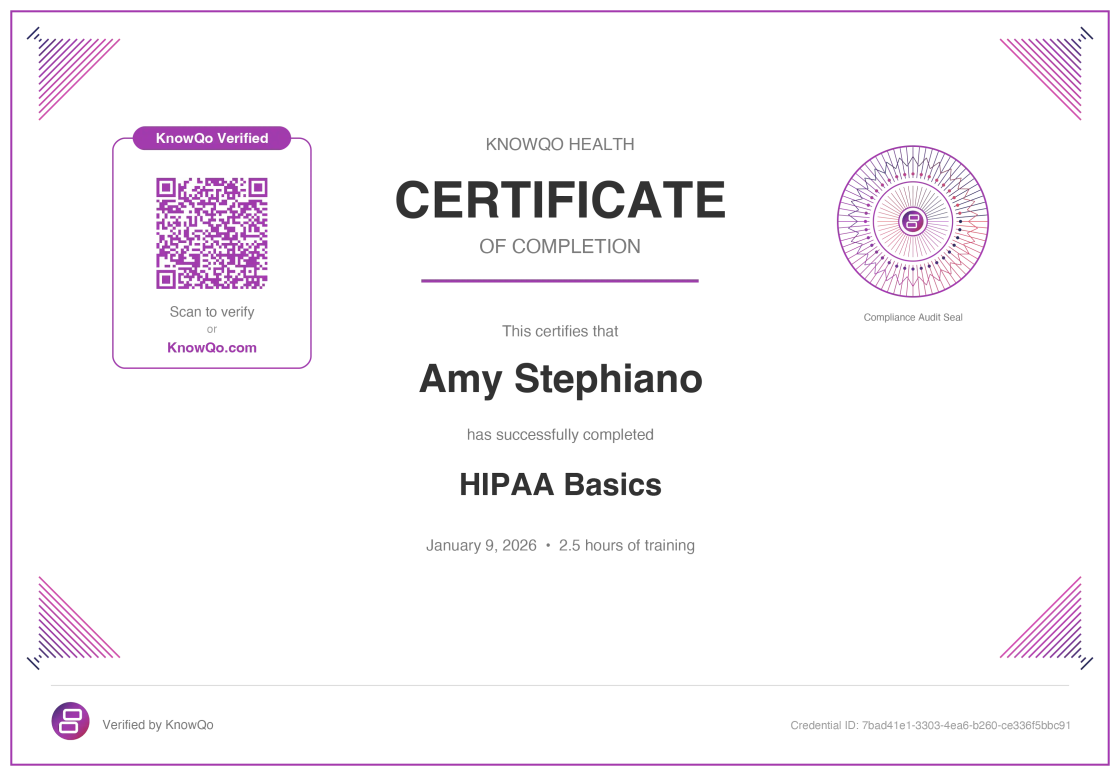
A real KnowQo HIPAA compliance certificate with QR verification code.
Scan Me
Free HIPAA Certification

Free HIPAA Certificate

Complete your HIPAA compliance training online, pass the exam, and earn a verifiable HIPAA certificate — free. Accepted by employers, shareable on LinkedIn, and backed by KnowQo's secure certificate ledger. No cost, no credit card, no expiration.

Free forever — no credit card Exam included Verifiable certificate

HIPAA Certificate that is...

Verifiable

Your HIPAA training certificate is stored on KnowQo's secure certificate ledger with a unique fingerprint. KnowQo certificates are perfect for sharing with employers, recruiters, or your LinkedIn community because they are universally verifiable.

LinkedIn Connected

In one click, you can publish your HIPAA training certificate to LinkedIn. You will become easier to find by healthcare recruiters with your LinkedIn-integrated certificate. Your certificate automatically links back to KnowQo's verifier, so it is effortless for recruiters to confirm your accomplishment.

Downloadable

Download your HIPAA training certificate in one click. Email your certificate to a recruiter, send it to an employer, or frame it and hang it on your wall.

Free. No hidden fees.

The training is free. The exam is free. The certificate is free. There is no paid tier, no upgrade required, and no credit card needed. KnowQo Health is a free learning community, not a free trial.

HIPAA Training that teaches...

1 Why it Matters
2 HIPAA Privacy Rule
3 HIPAA Security Rule
4 HIPAA Breach
Final Exam
1Why it Matters

What is HIPAA?

The Health Insurance Portability and Accountability Act (HIPAA) is a federal law enacted in 1996 that establishes national standards for protecting sensitive patient health information. It applies to healthcare providers, health plans, healthcare clearinghouses, and any business associate that handles protected health information on their behalf.

Criminal Liability

HIPAA violations can carry serious criminal penalties and can result in fines of $250,000 and ten years in prison.

Join KnowQo to Learn More

This is just a sample of our curriculum, please join KnowQo to get the entire HIPAA Training curriculum.

2HIPAA Privacy Rule

Protected Health Information

Any "individually identifiable health information" that is shared by covered entities (CEs) or Business Associates (BAs) is protected under HIPAA. If it includes a personal identifier + health info, it is PHI. As a rule to live by, never disclose PHI to anyone except the patient to whom it belongs. A few exceptions do exist, and they will be discussed in the next section.

Minimum Necessary

A key part of the HIPAA Privacy Rule is Minimum Necessary. As a rule to live by, it is best to share as little PHI as possible (the minimum necessary).

Notice of Privacy Practices

CEs must provide an explanation of their privacy practices to patients.Patients have the right to access their PHI. Exceptions do apply if accessing the health records could harm the patient. Patients have the right to request that their health records be modified. CEs have the right to reject these requests. Patients can request a list of who their PHI has been shared with (outside of treatment, payment, and operations). Patients have the right to request a CE limit access to their PHI; however, a CE can reject this request.

Join KnowQo to Learn More

This is just a sample of our curriculum, please join KnowQo to get the entire HIPAA Training curriculum.

3HIPAA Security Rule

Overview

The HIPAA Security Rule establishes national standards for protecting electronic protected health information (ePHI). It requires covered entities to implement safeguards — administrative, technical, and physical — to ensure the confidentiality, integrity, and availability of all ePHI they create, receive, maintain, or transmit.

Administrative Safeguards

Regulated entities are required to have policies, procedures, and people responsibilities that protect ePHI—think management, training, and oversight rather than technology or physical security. Specifically, organizations must assess risks, designate a security official, manage workforce access, train employees, respond to incidents, plan for emergencies, and periodically evaluate their security measures. Business associate agreements must be in place before a BA can handle ePHI.

Technical Safeguards

Technical safeguards focus on the technology that protects ePHI. Organizations must ensure only authorized users can access ePHI, track activity in systems, prevent improper changes or destruction of data, verify user identities, and protect ePHI when transmitting it over networks.

Physical Safeguards

Physical safeguards focus on protecting the actual facilities, equipment, and devices that store or access ePHI. Organizations must control who can physically access these spaces, establish rules for workstation use and security, and manage how devices and media containing ePHI are moved, reused, or disposed of—including wiping ePHI before discarding hardware.

Security Rule Documentation

Organizations must create written policies and procedures to comply with the Security Rule. These documents must be kept for at least six years, made available to those responsible for implementing them, and updated as the organization or environment changes.

Business Associate Agreements

A written business associate agreement (BAA) must be in place before a BA handles ePHI. The agreement ensures the BA will comply with the Security Rule, report security incidents, and hold any subcontractors to the same standards.

Join KnowQo to Learn More

This is just a sample of our curriculum, please join KnowQo to get the entire HIPAA Training curriculum.

4HIPAA Breach

What is a Breach?

A breach happens when PHI is used or shared in a way that breaks the Privacy Rule and puts the information at risk. If PHI is used or shared incorrectly, it's assumed to be a breach unless a risk assessment shows the information probably wasn't compromised.

Documentation and Policies

Covered entities and business associates must keep records proving they made all required notifications—or that a notification wasn't required based on a risk assessment. Organizations must also have written breach notification policies and train their workforce on them.

Business Associate Breach

If a breach happens at a business associate, the BA must notify the covered entity within 60 days. The BA should also provide a list of affected individuals and any other information the covered entity needs to notify them.

Join KnowQo to Learn More

This is just a sample of our curriculum, please join KnowQo to get the entire HIPAA Training curriculum.

Frequently asked questions

Can I get my HIPAA certification for free?

Yes. KnowQo Health is a free learning community, not a free trial. The training is free, the exam is free, and the certificate is free. There is no paid tier, no upgrade required, and no credit card needed. Our learners never pay a cent. This works because we have a large suite of healthcare compliance tools that we sell to healthcare organizations, allowing us to keep our HIPAA training free for individuals.

How much is a HIPAA certificate?

On KnowQo, a HIPAA certificate costs nothing. Some providers charge anywhere from $20 to $150 for HIPAA certification, but KnowQo Health is free. We make money with our healthcare compliance tools that we sell to healthcare organizations, allowing us to keep our HIPAA certificate free for the community.

How do I get a HIPAA certificate?

Sign up for a free KnowQo Health account, complete the four HIPAA training modules, and pass the final exam. Once you pass, your certificate is issued automatically and added to the KnowQo certificate ledger. The whole process typically takes less than two hours.

Join KnowQo Health

How long does it take to become HIPAA certified?

Most learners complete the KnowQo HIPAA certification in one to three hours (depending on experience level). The program is broken into four short modules followed by a final exam. You can work through it at your own pace: start, pause, and resume whenever it fits your schedule.

Does the HIPAA certificate expire?

HIPAA law does not specify a universal expiration period for training certificates. However, the HHS Office for Civil Rights recommends that covered entities retrain employees periodically (typically annually) as policies change. Many employers and licensing boards require annual renewal. KnowQo certificates display the date of issue so you can retrain on your own schedule.

Is HIPAA certification hard to get?

No. KnowQo's HIPAA certification is designed to be accessible to anyone working in or around healthcare — regardless of their background. The program is designed to suit all learner types. The training is made up of video (with closed captions), reading (with text-to-speech support), and quiz questions. At KnowQo we are dedicated to ensuring our learning fits a wide range of learning styles. The training is clear and practical, and the exam tests real-world understanding rather than memorization. Most learners pass on their first attempt. You can retake the exam as many times as you need to pass.

Who gives out HIPAA certification?

HIPAA certification is not issued by a government agency — the Department of Health and Human Services (HHS) does not certify individuals or organizations. Instead, certification is issued by training providers like KnowQo. KnowQo certificates are verifiable through our certificate ledger, which provides a unique fingerprint and QR code for each credential.

Is HIPAA certification worth it?

Yes, especially if you work in healthcare, health tech, medical billing, or any field that involves patient data. Many employers require it before hire. It strengthens your resume, demonstrates professional accountability. On KnowQo, training on the HIPAA law is free as is the certificate of completion.

Join free now

How many questions are on the HIPAA exam?

The KnowQo HIPAA final exam has 12 questions and you have 1 hour to complete it. That said, most people complete the HIPAA exam in 10 to 15 minutes. The exam covers the key concepts from all four modules: the Privacy Rule, Security Rule, breach notification, and foundational HIPAA law.

Can I get a HIPAA certification online?

Yes. KnowQo is fully online. You can complete your HIPAA training, take the exam, and receive your verifiable certificate entirely from your computer or phone. No software to install, no in-person session required.

Join online now