Employed vs. Unemployed: Who Are More Motivated Learners?
Introduction
Employed vs. Unemployed
Here at KnowQo we do something unique: we offer the same training for free to organizations and to individuals.
When a dental office assigns OSHA Bloodborne Pathogen training, it's the same curriculum an independent job-seeker completes through KnowQo Health. When a Business Associate assigns HIPAA training, it's the same course someone pursuing a healthcare data career takes on their own.
In all cases, the curriculum is identical: bite-sized, multi-modal learning engineered for adult learners. The platform captures learner sentiment and competence in real-time.
KnowQo's unique approach creates a natural experiment: two groups completing identical training:
Employed Learners: Individuals whose employer uses KnowQo's compliance platform. They complete the training because it's assigned to them — a job requirement.
Job-Seeking Learners: Individuals accessing KnowQo Health independently. These learners are largely pursuing certification to improve their employability.
Both cohorts experience identical conditions: the same curriculum, the same platform, and the same certificate upon completion. The barrier to entry is equivalent — training is free for both organizations and individuals. The only variable is the source of motivation: extrinsic (employer-assigned) versus intrinsic (self-initiated).
This allows us to isolate a single question: Does motivation affect learning outcomes when all other variables are controlled?
Methods
Data Source
The dataset comprises lesson-level completion records from KnowQo's platform, spanning a two-month period (January–March 2026). The sample includes approximately 40,000 lesson completions across HIPAA and OSHA Bloodborne Pathogen training modules.
Data Cleaning
Records were filtered to include only lessons completed on or after January 10, 2026. Lessons exceeding 300 seconds (5 minutes) were excluded, as these likely represent abandoned or idle sessions rather than active engagement. The final sample includes 32,634 lesson completions: 21,279 from Job-Seeking Learners and 11,355 from Employed Learners. Excluded records totaled 1,465 (4.3% of the filtered dataset).
Metrics
We measured three outcomes:
1. Time Spent — Duration of active engagement per lesson, measured in milliseconds and converted to seconds for analysis. Learners control their own pacing: videos may be rewatched, text may be re-read or played via KnowQo's text-to-speech feature. The timer begins on lesson start and ends when the learner advances.
2. Quiz Accuracy — A subset of lessons include inline assessment questions. Accuracy is calculated as the percentage of correct responses.
3. Learner Sentiment — KnowQo captures self-reported learner sentiment at the conclusion of each lesson.
Results
Time Spent
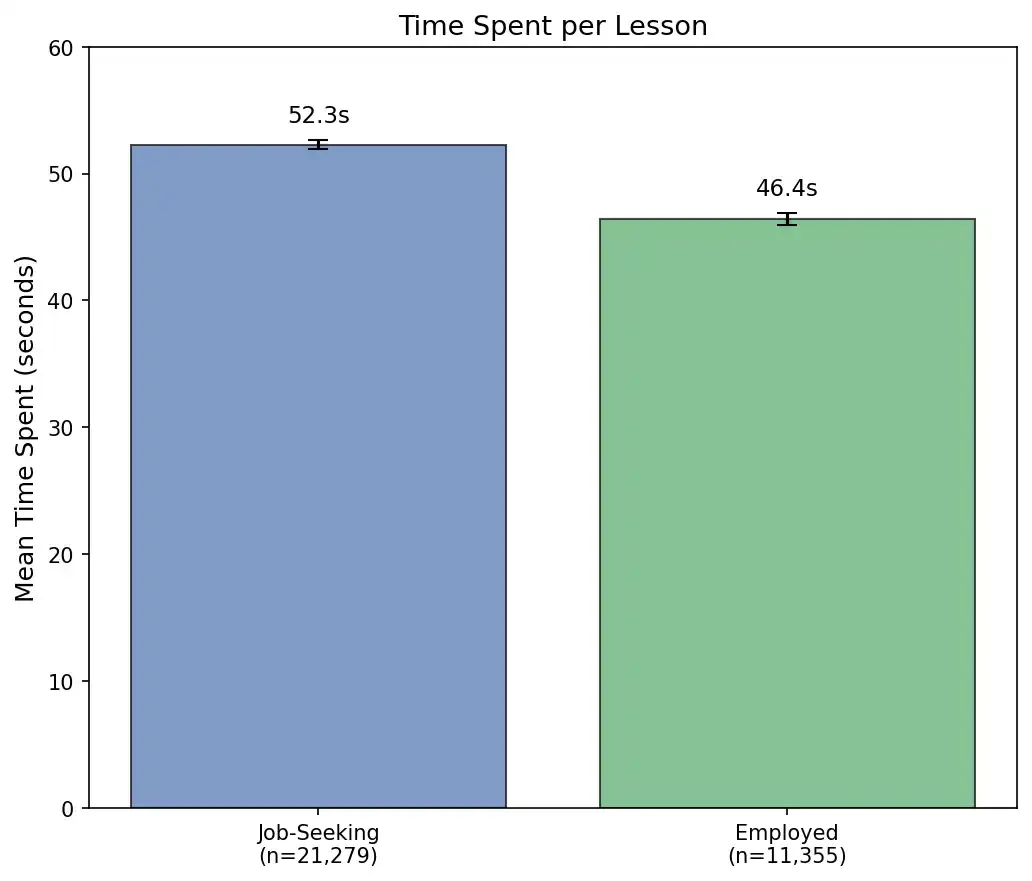
Job-Seeking Learners demonstrated significantly longer engagement times per lesson.
| Metric | Job-Seeking | Employed |
|---|---|---|
| N | 21,279 | 11,355 |
| Mean | 52.3s | 46.4s |
| Median | 34.2s | 29.4s |
| Std Dev | 54.6s | 50.7s |
Welch's t-test: t = 9.72, p < 0.0001
Quiz Accuracy
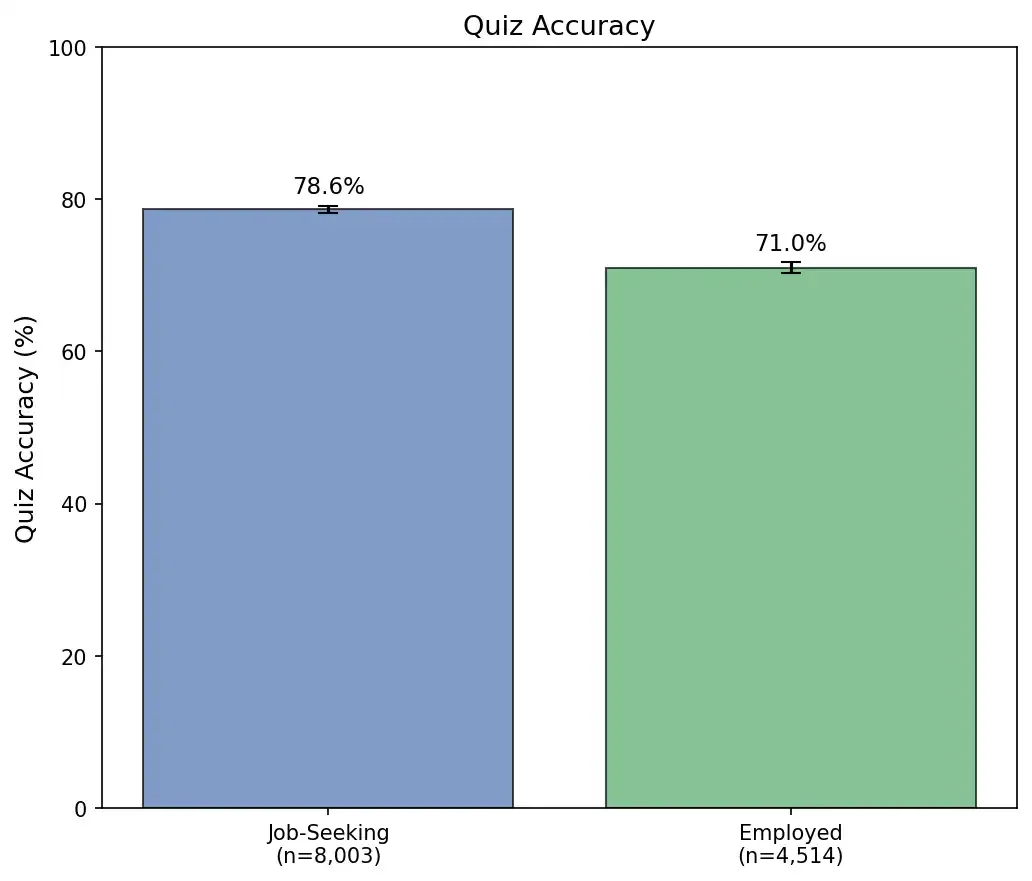
Job-Seeking Learners demonstrated significantly higher quiz accuracy.
| Metric | Job-Seeking | Employed |
|---|---|---|
| Total Quizzes | 8,003 | 4,514 |
| % Correct | 78.7% | 71.0% |
Chi-square test: χ² = 92.26, p < 0.0001
Learner Sentiment
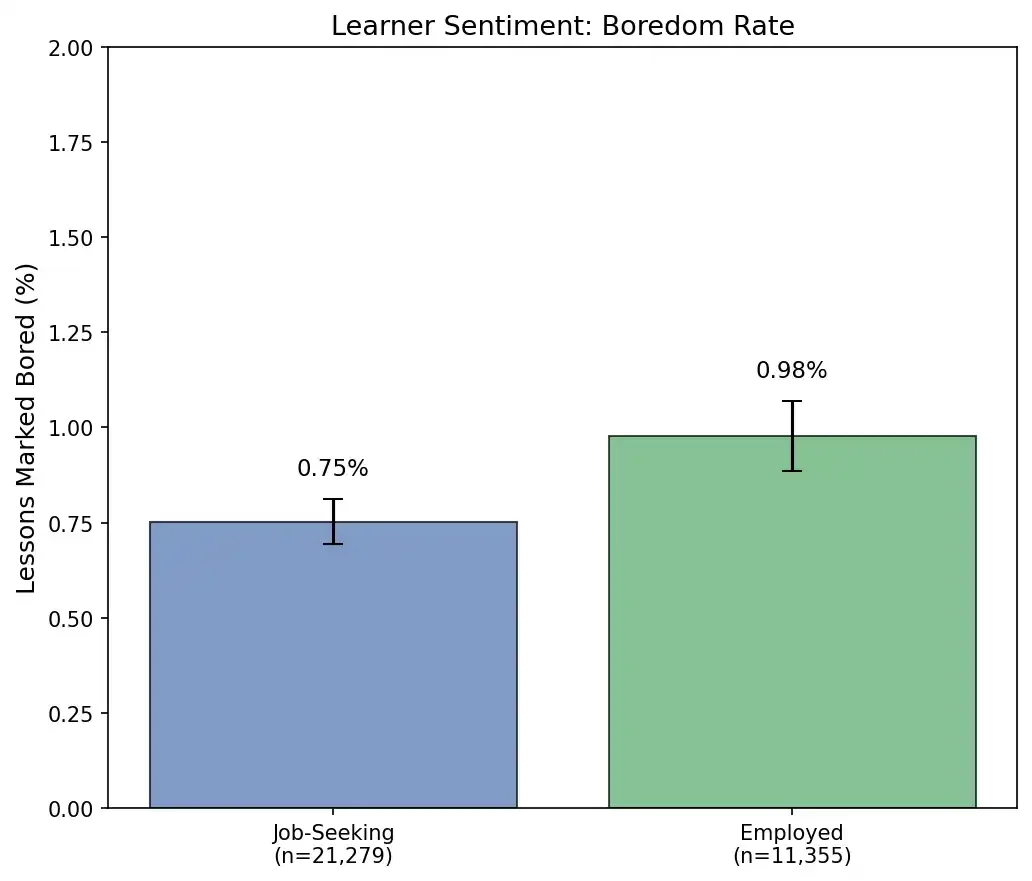
Job-Seeking Learners reported lower rates of boredom.
| Metric | Job-Seeking | Employed |
|---|---|---|
| Total Lessons | 21,279 | 11,355 |
| % Bored | 0.75% | 0.98% |
Chi-square test: χ² = 4.31, p = 0.038
Discussion
These findings are consistent with established motivation theory, but provide empirical support for what is often assumed: intrinsically motivated learners engage more deeply with training material.
Across all three metrics, Job-Seeking Learners outperformed Employed Learners. They spent more time per lesson, achieved higher quiz accuracy, and reported lower rates of boredom. All differences were statistically significant.
The natural experiment design — identical curriculum, platform, credential, and cost — controls for confounding variables and isolates motivation as the differentiating factor.
These results suggest that employers may benefit from policies that afford employees greater autonomy in when and how they complete required training.
Conclusion
This natural experiment provides empirical evidence that learner motivation significantly impacts training outcomes — even when content, platform, and credential are held constant.
The study was made possible by KnowQo's unique model: free healthcare compliance training — including HIPAA certification, OSHA certification, and Bloodborne Pathogen certification — available to both organizations and individuals.
For employers, the implication is clear: how training is assigned may be as consequential as what training is assigned.
Appendix
*KnowQo Health — KnowQo's public-facing healthcare compliance training portal. Individuals can access free HIPAA, OSHA, and Bloodborne Pathogen training and earn certificates of completion, independent of any employer affiliation.